BAYES ACADEMY
|
CURRICULUM
SENSEI.LOG
STATUS:●ONLINE
RANK:LV.42
STREAK:07 days
BONDS:♡ 24/30
AP:120/180
BULLETIN
[8/31] NIHAHAHAHAHAHAHA!
[8/31] NIHAHAHAHAHAHAHA! [8/31] NIHAHAHAHAHAHAHA! [8/31] NIHAHAHAHAHAHAHA! |
Digital Autonomy and Free Speech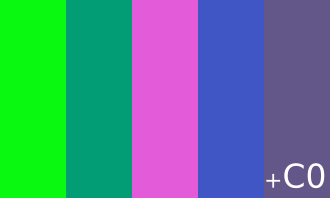 Hi. This is not Koyuki speaking, but the creator of this website. There's a flag I want to tell you about. It's called the Free Speech Flag, and at first glance it just looks like five colored stripes with a bit of white text in the corner, but the whole thing is actually a number. Specifically, it's an encryption key, the one that used to unlock the copy protection on DVDs and Blu-rays, encoded as hex color codes (09 F9 11 02 9D 74 E3 5B D8 41 56 C5 63 56 88 C0, if you want to write it out in the more familiar form). The flag was born from a controversy back in 2007, when people online started sharing this number because it let them copy discs they'd already paid for, and the organization in charge of DVD encryption tried to make it stop. They sent cease and desist letters to one of the biggest platforms of the day. The platform tried to comply. And of course, the moment they tried, the entire internet noticed, and the number spread everywhere; it ended up in song lyrics, on t-shirts, in poems, in artwork, in flag form, and on every single front page of the site that had originally tried to suppress it. It became, quite literally, an unsuppressable string of sixteen bytes. I bring this up because the whole episode raises some interesting questions. Can a number be intellectual property? What if you express it as an equation, or convert it to base 64, or sing it as a melody, or paint it as a flag? If you bought the DVD and you own the DVD, why aren't you allowed to copy the DVD? And, the question that lurks under all of this, do corporations have more rights than the individual people they sell to? Now, almost twenty years later, we live in a world where these kinds of questions have only multiplied, where words like "hate speech" and "misinformation" and "harmful content" get tossed around as though they were stable, agreed-upon categories, and where self-described liberal democracies are increasingly happy to criminalize them, while the corporations, platforms, and payment processors that mediate almost all human communication enforce their own private versions of the same thing through terms of service nobody reads and community guidelines that change every six months (and often capitulating to the whims of authoritarian governments). So I want to lay out, in no particular order, the reasons I think this whole arrangement is a mistake, and what I think actually defending freedom of expression looks like in practice. (I should warn you upfront that I'm not going to be especially diplomatic about it. I find the modern habit of dressing up censorship in soft therapeutic language genuinely insulting.) Before any of the specifics, there's a single question worth sitting with for a moment: who, exactly, do you trust to decide what you're allowed to read, say, or even think? Not what you should read or say (which is your business and frankly nobody else's), but what you're permitted to. And whatever answer you arrive at, ask yourself whether you'd hand that same authority to the person you consider your worst political enemy. Because the structure of power being what it is, you eventually will. That little thought experiment is the foundation of everything else. The first thing worth recovering is the old distinction between speech and action, which has been quietly eroded over the past decade or so. Saying "I hate my neighbor" is not the same as harming your neighbor. Saying "this policy is stupid" is not the same as sabotaging the policy. Saying "I'm going to kill myself" is not the same as killing myself. Calling someone a slur is not the same thing as harming them, nor is it your responsibility if they react with violence. Similarly, simply being an annoying cunt who says shit that pisses people off (e.g., Socrates) shouldn't be criminalized. When we punish the speech, we're not punishing a harmful act, we're punishing the possibility that some person, somewhere, might be moved by hearing it to do something we don't like. Which treats human beings as input-output machines that automatically execute whatever ideas they're exposed to, rather than as autonomous minds that hear things and decide for themselves. If a person commits violence, prosecute the violence. If a person commits fraud, prosecute the fraud. The harm is in the act. To punish the words is to punish thought through its nearest observable proxy, and once you start doing that there's no principled place to stop. It also bears saying that speech is not just one freedom on a list with others; it's the freedom that makes the rest of them possible. You can't have freedom of religion without the freedom to articulate religious beliefs. You can't have freedom of assembly without the freedom to discuss why you're assembling. You can't have democratic participation without the freedom to criticize whoever happens to be in power, and you can't have science without the freedom to challenge whatever the current consensus happens to be (and the current consensus, historically speaking, has been wrong more often than it's been right—that's literally how science works). You can't even have a fair trial without the freedom to argue your case. Restrict speech, and everything downstream gets weaker in ways that aren't always visible at the time. Now, the modern justifications for restricting speech come dressed in two main outfits: "hate speech" and "misinformation." The trick with both of these terms is that they sound like neutral descriptions of stable, universal categories, when in fact they are subjective judgments wearing the costume of descriptions. Try this exercise: write down a definition of "hate speech" or "misinformation" that (a) is precise enough that two strangers, given the definition and a hundred random statements, would label every statement the same way; (b) doesn't depend on who is speaking or who is listening; and (c) wouldn't have been used at some point in the past century to silence civil rights organizers, anti-war protesters, scientific dissenters, or whistleblowers. It is, I would suggest, essentially impossible. Not because cruelty and falsehood don't exist, but because the boundary is irreducibly subjective. What one generation calls hateful, the next calls obvious. What one government calls misinformation, another calls investigative journalism. The category isn't a fact, it's a verdict, and verdicts require judges, and judges have interests. Consider just how the "misinformation" label has aged over the past few years. Claims labeled misinformation later turned out to be plausible or even useful. Claims labeled correct turned out to be incomplete, misleading, or quietly abandoned. Topics that were unspeakable in 2020 are now discussed openly in mainstream outlets with no real reckoning for the years of enforcement in between. This isn't a partisan observation; it's simply what happened. Now, I could give the classic Mill-style "marketplace of ideas leads to truth" argument, but I would argue that the deeper problem isn't that the institutions got a few calls wrong. It's that truth itself (particularly regarding human systems) is often not a stable object waiting to be discovered and pinned down. It is constructed within particular goals, fears, and feedback loops—what we choose to notice, what we are rewarded for seeing, and what questions we are allowed to ask. When you build permanent enforcement architecture around the judgments of any moment, you don't protect truth—you freeze one contingent construction of reality in place. You shrink the space of permissible questions, homogenize human experience under the priorities of whoever holds the stamp, and make the whole system more blind and brittle to uncertainty. The people who later shifted the conversation would have been silenced not because they were objectively wrong, but because they threatened the operating goals of the enforcers. Truth that relies on authority to be true is just power wearing better clothes. There's a related problem, which is the question of where speech ends and "incitement" begins. At what point does criticism become incitement? At what point does heated rhetoric become a threat? At what point does mockery or unsavory language become hate? Wherever you draw that line, someone with power will move it, and they will move it in whatever direction benefits them. A government can simply declare that criticism of its policies "incites unrest," and the whole legal apparatus you built to combat genuine incitement now exists to silence dissent. This is why the only stable position is to punish the act, not the speech that allegedly led to it. If someone commits violence, punish them. If someone organizes a specific, imminent crime with other people, that's already conspiracy, which is a narrow and well-defined category. But punishing words for their imagined downstream effects is just punishing thought with extra steps. (I want to address something here, because I know how these arguments are typically received. People will say: "But isn't that just the slippery slope fallacy?" And the answer is that the slippery slope is only a fallacy when the slope is imaginary. It is not a fallacy when the slope is a documented historical pattern, and in this particular case it is.) Every authoritarian regime in modern history has used the exact same vocabulary that's now being deployed in democracies, just with the dial turned further. Russia is the cleanest example, because the rhetoric is now nearly identical. Russia has laws against "discrediting the armed forces" and "fake news," which is a misinformation law in everything but name. Russia has laws against "LGBT propaganda," which is the same hate speech machinery pointed in the opposite direction. Russia has laws against "extremism" that conveniently apply to peaceful protesters, opposition candidates, and journalists. Russia blocks websites, compels platforms to remove content, and prosecutes individual citizens for social media posts, and every single one of these actions is justified using the language of "protecting society," "preventing harm," and "fighting disinformation." China uses identical justifications. So does Iran. So did East Germany. So does every regime that has ever wanted to control what its population is allowed to think. The point is not that any specific Western proposal is the same as a Russian law. The point is that the mechanism is the same, and the mechanism, once built, is available to whoever holds the keys next. Laws outlast the governments that pass them. Infrastructure outlasts the people who built it. Whatever censorship power you grant to your side will eventually, inevitably, be used by some other side, because parties alternate, platforms get sold, bureaucracies shift priorities, and the people running things in twenty years are not the people running things now. The most common dodge against this is the "private company" argument: it's not censorship if a private company does it, they can do whatever they want, free market, etc. There are a few things wrong with this. First, when just a few companies essentially control the global communication infrastructure, the distinction between "private" and "public" becomes mostly cosmetic. If a small number of platforms can collectively render a topic effectively unspeakable across most of the internet, the practical effect on public discourse is identical to government censorship, regardless of which legal category we file it under. Second, governments and corporations have spent the last decade increasingly coordinating with each other. When officials lean on platforms to remove content, when agencies maintain back channels to trust-and-safety teams, when regulatory threats hover over moderation decisions, the line between state action and corporate action stops meaning very much. Censorship laundered through a private company is still censorship, just with a layer of plausible deniability bolted on. Third, freedom of expression is not synonymous with the First Amendment (if you're American), or with any specific legal text in any jurisdiction. It is a cultural commitment to the idea that people should be free to speak and hear ideas, and a society can lose that commitment entirely while leaving the legal text exactly where it was. And then there's the quieter version of censorship, the one that doesn't even require a takedown notice: algorithmic suppression. Removal is loud. Suppression is silent. Your post or website is still technically up, but nobody sees it. Your account still exists, but it doesn't reach anyone. The user who wanted to read it can't find it; the speaker doesn't know it didn't reach anyone; the conversation simply, quietly fails to occur. This is in some ways worse than overt censorship, because at least overt censorship can be fought. You can fight what you can see. You can't fight what you don't know is happening. And when the algorithms doing the suppressing are proprietary black boxes, the public has no way to audit what's being amplified versus what's being buried, and on what basis. The algorithm Gods feast in silence (and on you). Surveillance is the other half of this, and it's inseparable from the speech half, even though people tend to treat them as separate concerns. The reason is simple: people don't speak freely when they're being watched. This is true in elevators, in interrogation rooms, in classrooms, and online. The mere awareness that what you say is recorded, analyzed, archived, and potentially retrievable for the rest of your life changes what you'll say, and more importantly, what you'll even let yourself think out loud. This is called the chilling effect, and it doesn't require any actual punishment to function. It only requires the possibility of punishment combined with the certainty of observation. People self-censor preemptively. Whole categories of thought go unexpressed and therefore undeveloped. Dissent never quite forms, because the cost of being noticed is too high. A surveilled population is a quiet population, even if nobody is ever actually arrested. This is what makes it so insidious; the visible consequences are minimal precisely because the invisible ones are doing all the work. And consider what now passes for normal: operating systems that send your activity back to the manufacturer by default; phones that track your location every few seconds and share it with dozens of third parties you've never heard of; smart speakers that listen ambiently in your bedroom; workplace software that records keystrokes and screenshots; cars that report your driving behavior to insurers; browsers and apps that fingerprint your device across the entire web; payment systems that compile complete records of your purchases, your movements, and who you spend time with. Each of these was introduced as a feature, a convenience, a safety improvement, or a way to "personalize your experience." Collectively, they form a surveillance apparatus more detailed and intrusive than anything the Stasi or KGB (or even George Orwell's fictional Big Brother) could have built in their wildest fever dreams, and most of us carry the bulk of it around in our pockets, voluntarily, often having paid for the privilege. There's a particular structural reversal I want to name here. In a free society, the citizen is opaque to the state and the state is transparent to the citizen—in other words, transparency is the condition for power over others (and the precondition for enabling trust). The government has to justify its actions in public, and the citizen is presumed innocent and entitled to a private life. Mass surveillance inverts the whole arrangement: the citizen becomes transparent (every message, movement, transaction, and association on file somewhere), and the state becomes opaque (its surveillance programs hidden behind classification, technical complexity, and the kind of bureaucratic shrug that makes auditing them effectively impossible). This is not a small drift. It's the structural inversion of the relationship that defines a free society in the first place, and it has happened in roughly the span of one generation, mostly while we were distracted either through easy dopamine hits from platforms farming engagement and turning attention into capital (and your attention is literally the basis of your cognition and agency) or endlessly posturing and arguing with each other over petty culture wars with meaningless buzzwords and moral panics. I want to step back for a second and remember that the open internet, briefly, was something genuinely new in human history. Throughout almost all of history, control over information has been the foundation of control over populations. Whoever controlled the printing press, the broadcasters, the newspapers, the textbooks, the libraries: they controlled the boundaries of what was thinkable. For a brief window, the internet broke that. An ordinary individual could publish to a global audience without asking anyone's permission. A whistleblower could release documents directly to the public. A dissident in one country could reach readers in another. A scientist could share results without a journal's blessing. An ordinary person could fact-check a politician in real time and broadcast the correction. This was, I think, genuinely revolutionary, and it explains a lot about why every existing power center (governments, corporations, legacy media, intelligence agencies, academic institutions, NGOs) has spent the last decade trying so hard to put the genie back in the bottle. The mechanisms vary (content moderation, algorithmic curation, identity verification, payment processor restrictions, app store rules, "trusted news initiatives," domain registrars deplatforming whole sites), but the goal is consistent: re-establish the gatekeepers, just under newer and more flattering names. So here is the real question, the one that should always sit at the center of any conversation about "harmful" speech. The question is not whether some speech is harmful (whatever that means in a given moment to a given person). Some speech probably is, by some definition—perhaps even this very text I'm writing if you're a paranoid dictator or politician. The question is whether the cure is worse than the disease. And the answer, when you actually look at how these systems function and how they evolve over time, I would say is almost always yes. Every system designed to suppress harmful speech will also suppress valuable speech, because the people running the system can't reliably tell the difference, and even when they can (or, rather, when you're lucky enough that their definitions align with yours), their successors won't. Every system designed to identify dangerous individuals will eventually identify dissidents, journalists, and ordinary people who happen to be inconvenient to whoever is in power. Every system designed to protect us will, sooner or later, be used against us. So the answer isn't "harmful speech doesn't exist." The answer is that any authority empowered to define and punish it is more dangerous, in the long run, than the speech itself. More dangerous over time. More dangerous in aggregate. More dangerous across changes of government. More dangerous as the technology keeps getting better. A few principles fall out of all this almost on their own. Punish actions, not speech: violence, fraud, specific threats, and direct conspiracy to commit a crime are already illegal, and that is sufficient. Be deeply skeptical of any category whose definition shifts with the political season ("hate," "misinformation," "extremism," "harmful content," "dangerous individuals"); these are judgments wearing the costume of descriptions. Defend the principle when you dislike the speaker, especially then, because the protection only really matters when applied to speech you find objectionable (the easy cases require no defense). Treat surveillance and expression as two sides of the same problem; you cannot really have one without the other. Distinguish the system from its current operators; whatever powers you build will outlast whoever you currently trust to wield them. Resist the consolidation of platforms, payment systems, and identity systems, because consolidated infrastructure is censorship infrastructure waiting to happen, regardless of whether it's being used that way today. There's something else the censorship crowd almost never wants to admit, which is that censorship doesn't actually work very well, and it never has (just ask China how their pornography ban is going). It just produces an endless, expensive cat-and-mouse game, and human beings are far too creative for any version of it to fully succeed. People have been routing around restrictions on speech for as long as restrictions have existed. Under every empire, theocracy, dictatorship, monarchy, and bureaucracy, people have invented new words, new spellings, new puns, new metaphors, new emojis, new symbols, and sometimes entire coded languages, just to keep saying what they wanted to say (which, again, is exactly how the Free Speech Flag at the top of all this came to exist in the first place). The patterns repeat. When a word gets banned, people invent a new one, and when that one is banned, they invent another, and the censor is always one step behind because language itself moves faster than any rulebook. When direct speech is dangerous, people switch to allegory, satire, fables, and jokes (some of the most important literature ever written exists precisely because the authors couldn't say what they meant plainly). When platforms ban words, users substitute numbers for letters, swap in homophones, intentionally misspell things, replace nouns with fruit emojis, or invent whole micro-vocabularies ("unalive," "seggs," "restarted," all the rest); these are just the latest examples of an ancient pattern. When entire languages are suppressed, communities preserve them privately and pass them down quietly. When books are burned, people memorize them. When sites are blocked, people mirror them. When accounts are banned, new ones appear within hours. And the ideas behind all these words (or any means of expression for that matter) don't magically disappear because no one uses them anymore. The deeper point is that expression is not a leak that can be plugged. It is a property of conscious beings interacting with each other. Until somebody implants chips in human brains that monitor and control thought at the source (and we should hope very, very much that we never get there, and probably resist with everything we have if it starts looking likely), suppression will always be partial, always lag behind, and always punish the slowest and most vulnerable while the clever and well-resourced route around it. Which is the real, ugly cost of censorship: it doesn't catch the sophisticated speaker, who knows the new rules and adapts; it catches the ordinary person who didn't know that last year's acceptable word is this year's slur, who used a joke that worked six months ago and gets punished for it now. It creates victims out of people who harmed no one, while the actually determined bad actors (whoever the actually determined bad actors are this week) simply adapt. It is, in net, a system that punishes victimless behavior, consumes enormous resources, and produces almost none of the safety it advertises. The collateral damage isn't a side effect of the policy. The collateral damage is the policy. So what do you actually do about any of this? Because abstract principles are nice, but they don't change anything by themselves, and I don't want to leave this as just another rant on the internet. The good news is that protecting your own digital autonomy doesn't require you to be a hacker or a hermit. It's a set of small, learnable habits, and each one shifts the balance back in your favor by a tiny amount, and collectively they add up to something that actually matters. For routine browsing, use a VPN. It's not magic, it's not perfect, and anyone who tells you it makes you invisible is selling something, but it does prevent your internet provider from logging every site you visit and selling that data to whichever broker is buying that week, and it makes mass surveillance more expensive, which is the realistic goal. Pick one that doesn't keep logs and isn't owned by some opaque holding company three corporate shells deep (I personally use Mullvad). Learn what Tor is, even if you don't use it every day, because Tor routes your traffic through multiple encrypted hops and makes it very hard to trace what you're reading or saying back to you. In a free country it's useful for when you want that extra level of privacy and anonymity. In an authoritarian country, or in one that becomes authoritarian later, it can be the only way to reach the open internet at all. Knowing how to use it before you need it is the entire point. Use a privacy-respecting browser (I personally use LibreWolf, but Firefox with some hardening is fine, or Mullvad Browser if you're extra paranoid) and a privacy-respecting search engine (I pay for Kagi, which offers a lot of user control and an AI assistant; for a free option with little setup, DuckDuckGo has its issues but is already a lot better than Google; or, even better, try SearXNG). Default browsers and default search engines are advertising products, which means you, the user, are the product being sold, and you should not pretend otherwise. Use encrypted, decentralized, and preferably open-source messaging apps. While apps like Signal and Telegram offer end-to-end encrypted communication, these are both centralized, require phone numbers, and have other privacy concerns. I personally prefer SimpleX Chat for simple one-on-one chats, and I increasingly use Matrix for community chats. SMS is not private. Default Facebook Messenger is not private, and even when you turn on encryption, Meta is the last entity I'd trust on the planet with anything, let alone what I say in private. Discord has no encryption, no privacy, and somehow manages to be even worse. Most of the "smart" messaging apps are not private. Encryption is what makes a conversation an actual conversation rather than a broadcast to whoever happens to have access to the server logs. Decentralization prevents a single authority from deciding what conversations and communities are allowed to exist and shutting down the entire operation on a whim. And open source both ensures accountability (so anyone can verify what's actually happening under the hood) and gives you the freedom to host it yourself and make your own rules. Learn the basics of Linux. You don't have to become a tech specialist or wear thigh-high socks. Just understanding that there is an alternative to Windows and macOS, and that you can actually own and control a computer end to end, will permanently change how you see your devices. Distributions like Linux Mint or Debian are friendly and run beautifully on hardware that Microsoft has unilaterally declared obsolete (although, Debian can be a bit finicky if your PC has a literal demon core, aka Nvidia, or requires other proprietary drivers; I personally use Arch, but I wouldn't recommend it if you're new to Linux or prefer user-friendliness over total user control). Prefer open-source software where you reasonably can. Open-source means anyone can audit the code for spyware, backdoors, or quiet malicious behavior. Closed-source software asks you to trust the company on faith. Open-source isn't automatically safer, but it is auditable, and auditability is the precondition for trust, not a substitute for it. Be skeptical of "smart" devices. A smart TV is a surveillance device that happens to play movies. A smart speaker is a microphone that happens to play music. Sometimes the trade-off is worth it, and sometimes it really isn't, but the honest question to ask is: would I install this if it were marketed truthfully as a surveillance device, because that is also what it is. Use a password manager (I personally use KeePassXC, which is open-source and free), turn on two-factor authentication for anything you'd hate to lose, and encrypt your devices, because full-disk encryption is built into every modern operating system and takes one toggle to enable; without it, a lost laptop or a stolen phone is an open book to anyone who finds it. Diversify away from the big-tech monopolies where you reasonably can. Use email providers that don't read your mail (Tuta, Proton, Fastmail, your choice; I personally use Tuta), especially for critical accounts and emails containing personal information. Try federated and decentralized platforms (Mastodon, Lemmy, Matrix, the Fediverse generally) alongside or instead of the big walled gardens; or, even better, learn some basic HTML, let your creativity flow, and make your own website! The goal isn't ideological purity, it's resilience: if you're spread across multiple platforms, no single deplatforming can erase your voice overnight. Self-host or use small providers when you can. A personal blog you control is a vastly more durable form of expression than a social media account that can vanish at the whim of whichever moderator drew the short straw that morning. Be skeptical of all centralized information sources, including mainstream media, government communications, institutional statements, viral social media, and yes, even the alternative outlets you happen to like (and even me!!!) This doesn't mean assume everyone is lying; it means assume everyone is human, with incentives, blind spots, and pressures. Cross-reference. Read primary sources when they exist. Notice what isn't being covered, not just what is, because the most powerful form of editorial bias is omission, and omission is invisible by definition. Be especially skeptical of anything that's free, anything that demands your real identity, and anything that won't tell you clearly what it does with your data. If you don't see the product, you are the product; that isn't cynicism, that is just the business model written plainly. If you can afford it, support independent journalism, independent platforms, and open-source projects with small recurring donations. The whole alternative ecosystem only exists because some number of people fund it, and a few dollars a month spread across a handful of projects is a meaningful vote for the kind of internet you want to still exist in ten years. Mostly though, it comes down to a mindset. Treat your data as part of you, because every piece of information you give away (your location, your contacts, your purchases, your search history, the rhythm of your day) is a small piece of leverage that someone else now holds over you, and they will use it eventually if it becomes useful enough. You can't always avoid this, but you can be intentional about it. Default to minimum disclosure. Apps and services routinely ask for far more information than they need to function, and saying no, or simply providing less, is almost always an option even though they design the interfaces to make you think it isn't. Learn more a little bit at a time. What a DNS resolver is. How HTTPS actually works. What metadata your photos contain. What a hardware security key does. None of this is rocket science, and every piece you understand makes you slightly harder to manipulate and slightly easier to recover when something goes wrong. And help the people around you, because your privacy often relies on other's privacy. A single private person surrounded by leaky devices isn't actually private; their messages get read on the other end of every conversation. Set up SimpleX or Matrix for a relative. Show a friend how to install Linux on the laptop they were about to throw away. The more people who practice basic digital hygiene, the safer the whole environment becomes for everyone, including you. None of these steps individually make you untouchable, and that isn't the goal. The goal is to be a slightly harder target than the default, to keep skills and tools alive in the broader population, and to refuse the quiet, creeping assumption that mass surveillance and platform consolidation are simply how things have to be now. Every person who uses encryption normalizes encryption. Every person who runs Linux helps keep that ecosystem viable. Every person who learns to use Tor before they need it makes the network more robust for someone, somewhere, who needs it desperately right this minute. Every person who questions a centralized platform helps fund and build its alternatives. You're not just protecting yourself, you're holding open doors that future people, possibly including a future version of yourself in circumstances you can't currently imagine, may very much need to walk through. Privacy and freedom are a journey, not a destination, and the journey only continues if people keep walking it. The last thing I want to say is also the simplest. None of this requires you to think every idea deserves respect, or that all speech is equally valuable, or that nobody ever lies. It only requires you to notice that the power to decide which ideas are permissible is itself the most dangerous power that exists in any society, that handing it to anyone (governments, corporations, algorithms, majorities, your favorite politician, your favorite billionaire, the smartest committee that has ever been assembled) eventually costs more than it saves, and that the open internet was not a gift from institutions and will not be preserved by them. It was built by individuals, and it continues to exist exactly to the extent that individuals keep choosing to build it, use it, and defend it. You don't have to agree with me on any of the particulars. That, finally, is the whole point. You get to decide. That is the thing actually being defended here, and I personally think it's worth more than whatever short-term comfort we'd buy by giving it up. Here's a non-exhaustive list of general sites (of various biases and perspectives) as a starting point to find more information and stay up-to-date:
To those who have read to the end: thank you. Never stop learning and never stop questioning everything. I personally don't believe in an afterlife, and I realize one day I will die (possibly tomorrow for all I know), and today's society is naturally tomorrow's lost civilization. I don't view this as pessimism or a form of defeat, but sobering and empowering. I want to get the most out of this tiny window of time I have to experience existence, explore the universe, and question as much as I can, and both censorship and mass surveillance are a direct affront to that. I love the internet, and I'm so glad my little window of existence coincides with it. Let's All Love Lain. |