BAYES ACADEMY
|
CURRICULUM
SENSEI.LOG
STATUS:●ONLINE
RANK:LV.42
STREAK:07 days
BONDS:♡ 24/30
AP:120/180
BULLETIN
[8/31] NIHAHAHAHAHAHAHA!
[8/31] NIHAHAHAHAHAHAHA! [8/31] NIHAHAHAHAHAHAHA! [8/31] NIHAHAHAHAHAHAHA! |
I am a Lolicon Hi. I'm the creator of this website, and I want to start here with something simple and direct: I am a lolicon. What does that mean? At its core, a lolicon is someone who appreciates lolis—cute, petite anime girls. This attraction can take many forms: sexual, romantic, or purely aesthetic. The term also refers to a genre of anime and manga that centers on these characters, sometimes in suggestive or erotic contexts. This is not a confession made lightly. As you might imagine, this topic carries an enormous amount of social and legal weight, particularly in Western countries. Lolicon is viewed by many as morally indistinguishable from pedophilia, treated as a gateway to abuse, or even condemned as abuse itself. The consequences of this perception are severe and far-reaching. In countries like Australia, the UK, and Canada, possession of lolicon content can result in arrest and even registration as a sex offender. On the internet, the suppression is nearly total: Reddit, Discord, BlueSky, and many other platforms ban it (or even allusion to it) outright; Google and other search engines remove it from results; LLMs at the simple mention of "lolis" often panic and hallucinate all sorts of nonsense relating it to pedophilia and sexual abuse; payment processors like Mastercard, Visa, and Paypal actively deny services for platforms that host it and artists that draw it, forcing content removal and blocking transactions (and now extending to adult content in general, resulting in the deletion of thousands of games from online storefronts). Even Rule34—named after the most well-known rule of the internet (if it exists, there is porn of it)—has ironically banned lolicon. Beyond institutional suppression, open lolicons often face harassment, doxxing, and death threats, especially online. Before I explain why all of this is absurd, I would like to stress that this situation is not merely about one niche interest. It is fundamentally about free speech, and the arguments that follow apply not just to lolicon but to all controversial fiction and artistic expression—gore, violence, blasphemy, deviant sexuality, and anything else someone might find "icky" or "obscene." Lolicon simply happens to be a canary in the coal mine: the first target of censorship that inevitably opens the door to broader suppression. Perhaps one of the most common objections is that lolicon "normalizes" harmful behavior or creates unrealistic expectations. The response to this is straightforward: we must normalize the separation of fiction from reality, and speech from action, through better media literacy. One can argue that Expression X might lead to Behavior Y indefinitely, but the more productive path is normalizing the understanding that X and Y are not the same thing. This distinction matters because arguments about normalization fundamentally undermine human autonomy. They presume that individuals cannot distinguish between fantasy and reality, that they lack the capacity for moral reasoning and self-control. So let me ask directly: If I showed you lolicon hentai, would you suddenly desire to have sex with children? And if you somehow did, would you also magically lose all capacity for self-control, for ethical reasoning, for understanding why harming a real person is wrong? (If your answer to either question is "yes," then I think that says more about you than anything else.) Most lolicons—and otakus in general—maintain a rigorous separation between 2D and 3D, between the fictional and the real (I myself am a 2D purist, both by choice and by preference). The "slippery slope" argument assumes a fragility of moral character that simply doesn't align with how most people actually engage with media, and it can easily be used to justify all sorts of censorship and authoritarian overreach. Many critics might point to overlap between lolicon consumers and pedophiles as evidence of danger. But this reasoning reverses conditional probability (see Lesson 1.2 in Chapter 1 of the Bayes Academy course if you haven't already). The probability that someone likes lolicon given that they are a pedophile is not equivalent to the probability that someone is a pedophile given that they like lolicon. While some pedophiles may consume lolicon content, the vast majority of lolicons are not pedophiles. This is analogous to claiming video games cause violence because a school shooter played Call of Duty. It ignores the millions of gamers who never commit violent acts. More importantly, it reverses causality: those inclined toward violence may gravitate toward violent media, just as pedophiles may gravitate toward content featuring young characters. The media doesn't create the inclination; the inclination seeks compatible media. In fact, if you look at empirical data, it actually suggests the opposite relationship. In Japan, where lolicon media is legal and relatively prevalent, rates of child sexual abuse are extremely low compared to countries that criminalize such content. In fact, some studies show sexual abuse of minors in Japan has decreased as lolicon media has spread. This pattern also holds more broadly: jurisdictions that legalize pornographic content typically show lower rates of sexual violence and abuse. Furthermore, vilifying lolicons ignores the reality of where child sexual abuse actually occurs. The overwhelming majority of cases (almost 90%) involve trusted family members or authority figures—parents, coaches, clergy, teachers. In other words, someone who occupies a socially legible position, is trusted, and has access to children. The archetypal otaku the panic invokes lacks all three: introverted geeks who rarely leave their homes, often alienated by the very society now casting them as its villains. "But what about unreported crimes?" This objection amounts to an argument from ignorance. Absence of evidence is not evidence of absence—or presence. One could just as easily argue that unreported crimes are being prevented by the availability of fictional outlets. We don't know what we don't know, and uncertainty should not justify enforced pseudo-certainty. To criminalize based on what might be happening invisibly is to willfully blind ourselves, like an emu with its head in the sand, or to never leave one's house for fear of being struck by a plane. A bigger issue of criminalizing or censoring lolicon lies in definition, as attempting to regulate lolicon runs immediately into definitional chaos. "Loli" is primarily an aesthetic category describing a body type, not an age. Characters designated as lolis can be 8, 18, 80, or even 8,000 years old. In Japanese usage, real adult women with petite or "child-like" bodies are routinely called lolis. If regulation targets visual appearance, it becomes inherently discriminatory against a specific body type—with real consequences. Adult women (and their partners) have faced unfair discrimination, particularly in the age of algorithms and AI, simply for fitting this aesthetic. Conversely, fictional characters can be 12 years old with "mature" physiques—what might look like a 30-year-old busty woman, might canonically be a child. And if we regulate based purely on stated age, we enter equally absurd territory. If you're 15 and your fictional anime crush is 15, do you become a pedophile when you turn 18 while she remains forever 15 in fictional animeland? If you imagine she's 18 in your headcanon, does that make it acceptable? Whose fictional authority determines age? If I, as a creator, randomly decide a character in my hentai is 15, does that retroactively make everyone who viewed her a pedophile? These aren't trivial philosophical puzzles. They expose the incoherence of attempting to apply real-world legal categories to fictional constructs. 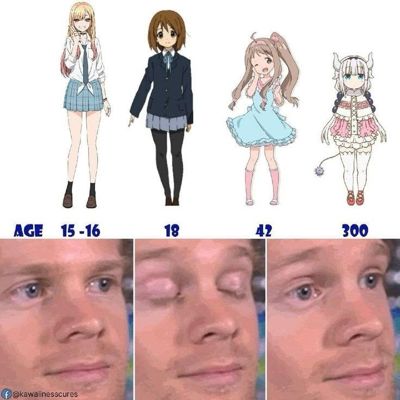 What about "male gaze" or misogyny? This framing collapses under scrutiny. Many lolicons are women, and some of the most celebrated works in the genre were created by women. The existence of shotacon—the male equivalent—and the robust markets for yaoi, yuri, and futanari demonstrate that this isn't simply men objectifying women; it's a broader ecosystem of fictional exploration across all demographics. More fundamentally, though, if it's fiction, it's fiction. The creator's gender doesn't grant or revoke the right to imagine! 
Kodomo no Jikan (aka Nymphet). A famous lolicon manga—and one of my favorite mangas—written by Kaworu Watashiya. This would've been the first of her works to be translated into English, except the publication of the English version was canceled due to its controversial content (controversial enough in the US that no vendors would sell it; most certainly illegal in the UK, Australia, and Canada). The story itself is about an elementary school teacher and his student who develops a crush on him; it's equal parts heartwarming, comedy, social criticism, and exploration of very heavy topics (and you should totally read it—while no official translations exist, fan translations do exist). Even if one accepts the premise that lolicon is harmful, censorship fails to eliminate it. It simply drives it underground. Users develop new language, code words, and emojis (hence the 😭 flag), building networks outside state (or corporate ...same thing?) surveillance. The practical effect is not protection but alienation: access to victimless fiction becomes as difficult to obtain as real abuse material, potentially pushing actual pedophiles away from harmless outlets and toward real criminal behavior. Still, criminalizing fiction is absurd for another reason: it is victimless. Its criminalization constitutes thought crime, creating unnecessary victims (the convicted) by ruining lives over fictional content and granting rights to literal cartoon characters. Every dollar spent policing fiction is a dollar not spent helping real abuse victims. Every hour spent harassing lolicons online is an hour not spent fostering environments where actual victims feel safe speaking up. If you genuinely care about children's well-being, the evidence suggests your time would be better spent donating to charities, supporting abuse prevention programs, and building support systems for real victims—rather than censoring drawings and threatening strangers on the internet. 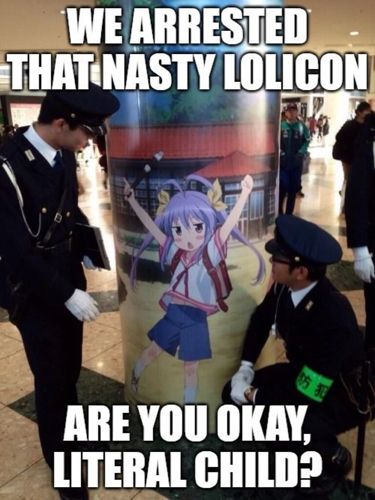 A bit of a side note: there also seems to be a Western double-standard here that becomes obvious when you examine what content remains readily available. Netflix hosts Big Mouth—an animated series explicitly about puberty that depicts nude child characters masturbating and exploring sexuality—which has won awards and critical acclaim. Game of Thrones featured sexual content involving teenage characters (e.g., Ramsay raping Sansa). Films like Blue is the Warmest Color, Pretty Baby, and American Beauty have depicted minors in sexual contexts with little more than ratings warnings (though, to be fair, not without their own share of controversy). Other Western animations like South Park and Rick and Morty regularly place child characters in extreme sexual and violent scenarios for comedy. And that's also not to mention all the Renaissance and libertine paintings out there filled with nude minors and angels on public display in museums and on the web. The difference here seems to be not the presence of sexualized minors in fiction—it's the aesthetic. When the depiction comes in the form of Western live-action or Western-style animation or classical paintings, it's 'art,' 'coming-of-age,' or 'edgy satire.' When it comes in Japanese anime style, it becomes 'pedophilia.' In other words, it may not even be objection based on a principled protection of children, but cultural prejudice against a specific medium and its consumers. (In fact, the content being targeted by payment processors, such as the games removed from storefronts, is disproportionately of Japanese origin and anime art style.) Anyways, as I stressed at the beginning, and would like to stress again: the arguments presented here extend far beyond lolicon. They apply to any fiction someone finds objectionable: violent video games, horror films, blasphemous art, sexual deviance in literature, and beyond. The pattern is always the same—moral panic, calls for censorship, implementation, and then the slow expansion of that censorship to adjacent forms of expression. Lolicon is simply one of the first dominos to fall because it falls victim to the "think of the children" narrative so easily. The alternative to all this nonsense is embracing complexity: acknowledging that humans can hold fantasy and reality as separate domains, that speech is not action, that correlation is not causation, and that uncertainty should not be weaponized into pretext for control. We can choose media literacy over moral panic, harm reduction over prohibition, and actual protection of children and real victims over symbolic punishment of fiction. The choice is always ours. But we should make it with clear eyes about what we're actually preserving—and what we're destroying. |